


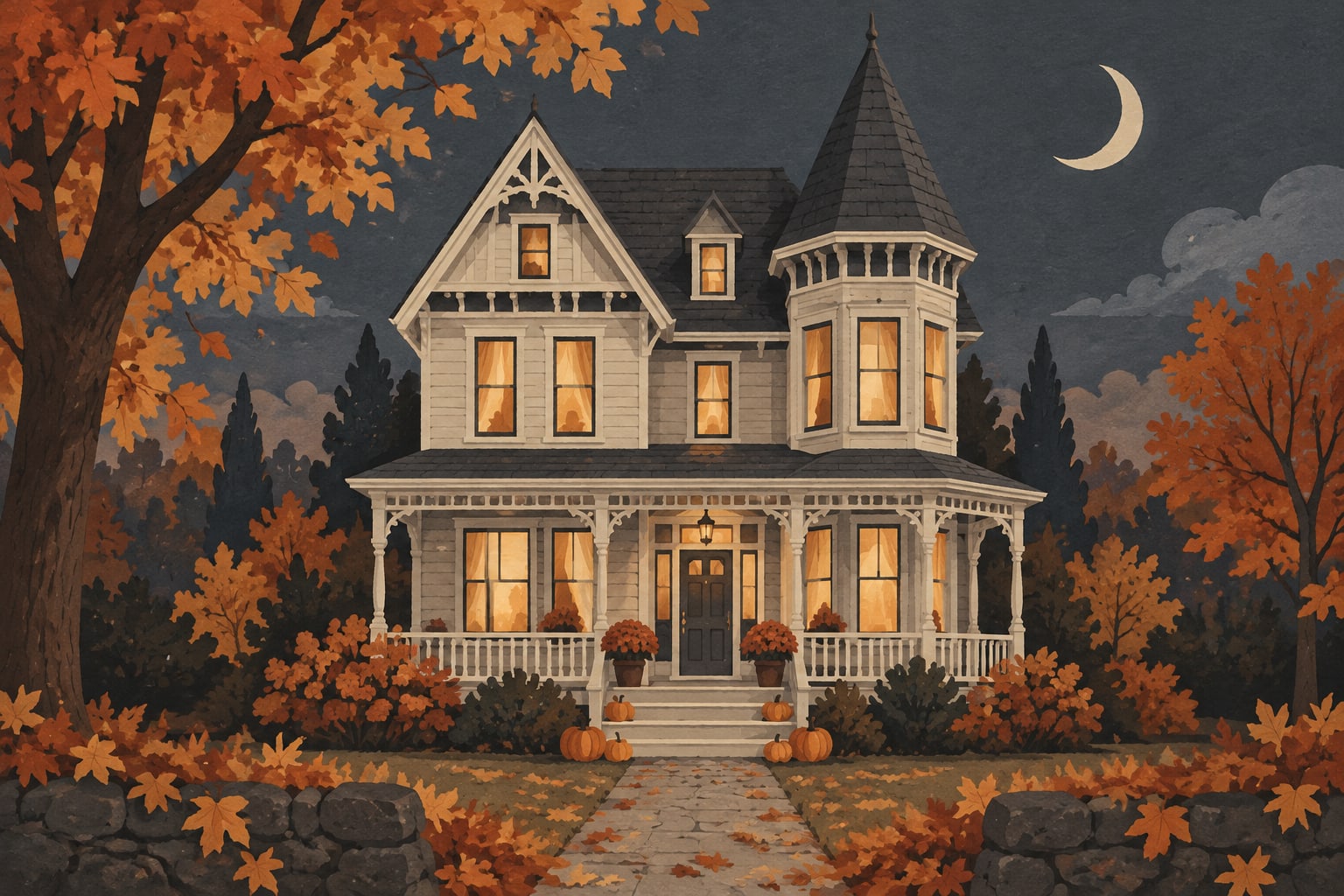

Illustration. This image is an illustration, not a photo of a specific home or a local haunted property.
By Erika Baños-Soria | Broker Associate, Coldwell Banker Envision
October 28, 2026
I've lived in California my entire life, so learning how differently other states handle things like family burial grounds sent me down a very Halloween-appropriate real estate rabbit hole.
A house with a ghostly reputation. Graves on private property. Questions about what a seller needs to tell a buyer. These sound like the start of a spooky movie, but they all have a place in real estate history and law.
Let's start with the house that ended up in court.
A house that was "legally haunted"
In the 1991 New York case Stambovsky v. Ackley, a buyer discovered that the home he had agreed to purchase had a well-known haunted reputation. The seller had shared ghost stories publicly, including in Reader's Digest and the local press.
The appeals court famously described the house as haunted "as a matter of law" and allowed the buyer's claim to cancel the contract to proceed.
Did a court prove that ghosts exist? No. The important part was the reputation the seller had helped create, and the fact that the buyer did not know about it. It was an unusual New York case, not a nationwide rule about haunted houses.
Sources:
Court opinion (https://law.justia.com/cases/new-york/appellate-division-first-department/1991/169-a-d-2d-254-572-n-y-s-2d-672.html)
·
Law Library of Congress (https://blogs.loc.gov/law/2024/10/how-a-house-becomes-legally-haunted-stambovsky-v-ackley-the-ghostbuster-ruling/)
A family cemetery can come with visitors
Another surprising real estate detail: buying land with graves on it may mean other people have a legal right to visit them.
Virginia, for example, has a law providing qualifying family members, descendants, cemetery plot owners and genealogy researchers reasonable access to graves on private property after reasonable notice. The owner can set limits on the frequency, hours, duration and, in some circumstances, the route. A deed or other written instrument creating or reserving the cemetery can change which rules apply.
So this is not a blanket right to show up whenever you want. And a law about access to existing graves is not permission to create a new backyard burial ground. State and local requirements still matter.
Source:
Virginia Code § 57-27.1 (https://law.lis.virginia.gov/vacode/57-27.1/)
What about California?
California generally requires human remains to be placed in a cemetery, with specific legal exceptions. Cremated remains have separate rules, so those should not be confused with an ordinary backyard burial.
Source:
California Health and Safety Code § 7054 (https://leginfo.legislature.ca.gov/faces/codes_displaySection.xhtml?lawCode=HSC§ionNum=7054.)
California also has its own rules about disclosing deaths on a property. An occupant's death on the property within the past three years generally needs to be disclosed, subject to exceptions and protections, including those involving HIV/AIDS. Civil Code section 1710.2 generally protects against liability for not volunteering an occupant's death that occurred more than three years before the buyer's offer. But it does not protect an intentional misrepresentation in response to a direct question about deaths on the property.
The practical takeaway: do not assume a rule from a spooky story in another state applies to a home here.
Sources:
California Civil Code § 1710.2 (https://leginfo.legislature.ca.gov/faces/codes_displaySection.xhtml?sectionNum=1710.2.&lawCode=CIV)
·
C.A.R. disclosure guide (https://www.car.org/-/media/CAR/Documents/Industry-360/PDF/PDFs/Quick-Guides/Quick-Guide--Disclosing-Death-on-a-Property-1025.pdf)
(revised 2017; checked against the current statute)
The real lesson for buyers and sellers
For buyers, ask the questions that matter to you early. Review the disclosures, inspections and title documents, and ask for help understanding anything unusual.
For sellers, bring questions about a property's history to your agent before deciding what to include or leave out. When a legal question needs more than a real estate answer, get advice from a qualified attorney.
A creaky floorboard can stay a Halloween mystery. Your home purchase should not.
Have questions about buying or selling in Glendora or the San Gabriel Valley Foothills? Let's talk about what to look for before your next move.
Erika Baños-Soria | Broker Associate
Coldwell Banker Envision | CalDRE 01809655
General information only, not legal advice. Laws and disclosure duties vary by location and circumstances.